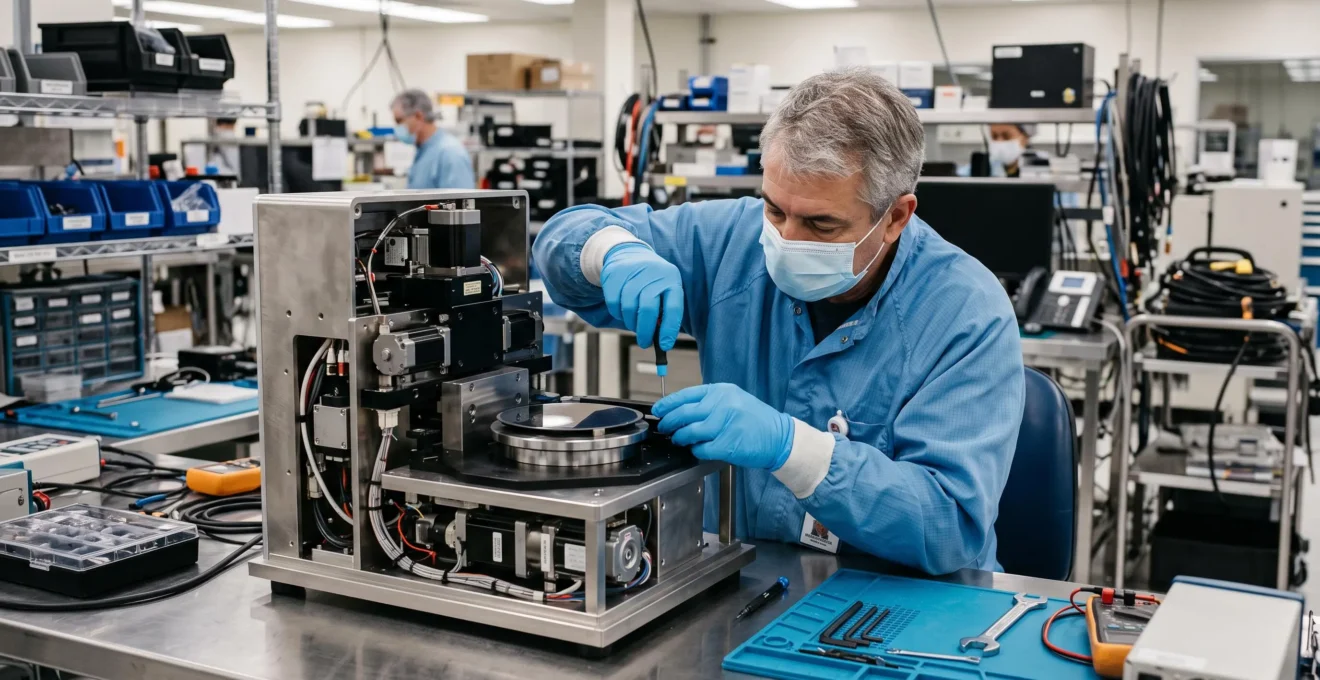
When a pre-aligner fails on a legacy semiconductor production line, the immediate reaction often assumes the worst: with the original equipment manufacturer (OEM) no longer supporting the tool, replacement seems inevitable. Yet this assumption conflates two distinct realities—end-of-life (EOL) commercial status and technical repairability. While an OEM may discontinue support and spare parts for older wafer handling equipment, specialized third-party providers have developed repair, exchange and refurbishment services specifically designed to restore these critical subsystems to original specification, extending production line life without the capital expense of a complete machine replacement.
A pre-aligner serves a precise but critical function in the wafer handling workflow: it corrects the rotational orientation of each silicon wafer before transfer to the next processing station, ensuring accurate positioning for lithography, inspection or other operations. Even minor degradation in pre-aligner repeatability can cascade into yield losses across an entire production run, making reliability non-negotiable. When the OEM declares a tool end-of-life, the support infrastructure—field service, spare parts inventory, software updates—ceases, leaving maintenance teams with limited options and mounting pressure to minimize downtime.
Direct answer: End-of-life status from the original manufacturer does not render a pre-aligner unrepairable. Third-party service providers specializing in legacy semiconductor equipment offer on-machine repair, exchange programs and full refurbishment using OEM-certified parts and documented test protocols, provided buyers verify process certifications, repeatability test data and warranty terms before committing.
When a pre-aligner fails on a legacy line: why obsolete does not mean unrepairable
A pre-aligner malfunction typically manifests as wafer misalignment errors, increased cycle times or outright transfer failures at the loadport. On a multi-generation production line, this single point of failure can halt throughput entirely, yet the equipment itself may represent only a fraction of a much larger, still-functional process tool. The challenge intensifies when the original manufacturer has discontinued the product line and closed the parts pipeline, a status formally described as end-of-life but often misinterpreted as a technical dead end.
End-of-life designation signals the end of a commercial relationship, not the end of mechanical or electronic serviceability. The OEM withdraws field service contracts, discontinues spare parts manufacturing and archives technical documentation, leaving fab maintenance teams without their primary support channel. Procurement Pro’s December 2025 analysis of EOL component management emphasizes that semiconductor production equipment is engineered for decades of operation, often outlasting the commercial lifecycle of the control electronics that govern it. The infrastructure sustaining these tools has shifted from OEM-exclusive to a distributed ecosystem of third-party specialists.
Specialized refurbishment providers have emerged to address this gap, building inventory stocks of OEM parts, reverse-engineering discontinued components and developing test protocols that replicate factory acceptance standards. Some providers, such as Eumetrys Robotics – Robot refurbishment and repair specialist, focus specifically on wafer handling subsystems including pre-aligners, loadports and atmospheric robots, offering services that range from component-level repair to complete unit refurbishment with documented traceability.
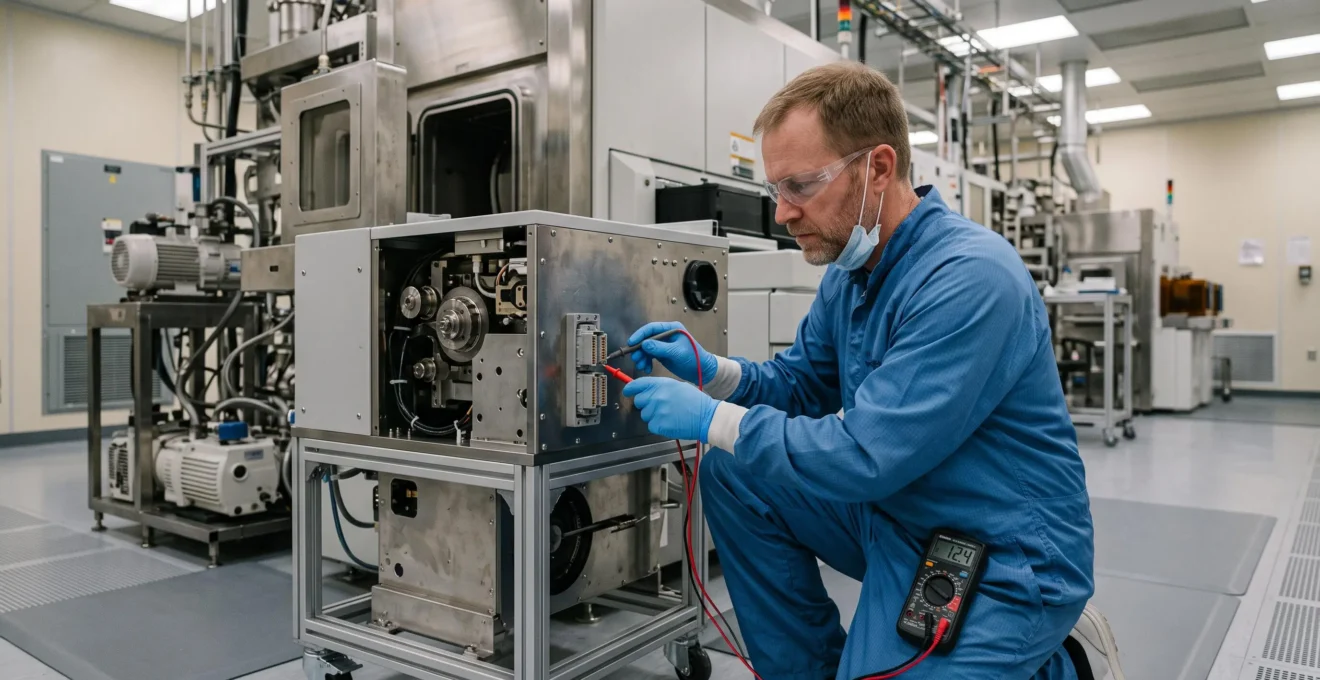
The distinction between OEM end-of-life and technical obsolescence matters because it reframes the decision tree. A tool declared obsolete by its manufacturer may still deliver years of reliable service if its mechanical wear can be addressed and its control systems maintained through alternative channels. The critical evaluation shifts from “Can this be fixed?” to “Which repair pathway offers the best balance of downtime, cost and long-term reliability given our production constraints?”
What are your options when OEM parts are no longer available?
Once OEM support ends, four pathways typically remain: on-machine repair using available spare inventory, full replacement of the process tool, third-party exchange programs and complete refurbishment of the failed unit. Each pathway presents different trade-offs in downtime, capital outlay, parts availability and risk mitigation.
On-machine repair attempts to restore the pre-aligner in place using whatever spare parts remain in internal inventory or can be sourced through distributor networks. This approach minimizes direct cost when parts are available but exposes the line to extended downtime if diagnosis reveals unavailable components or if the repair requires iterative troubleshooting. Without OEM field service, the burden of diagnosis, repair and validation falls on internal maintenance teams or contracted technicians who may lack tool-specific training.
Full machine replacement eliminates the uncertainty but introduces a capital expenditure often measured in hundreds of thousands to millions of dollars, depending on the process tool category. As noted in industry procurement analyses, even non-EUV semiconductor manufacturing equipment represents substantial investment, and the lead time for new equipment can extend to months, compounding production schedule disruption. Replacement may also trigger process requalification, adding further delay and expense.
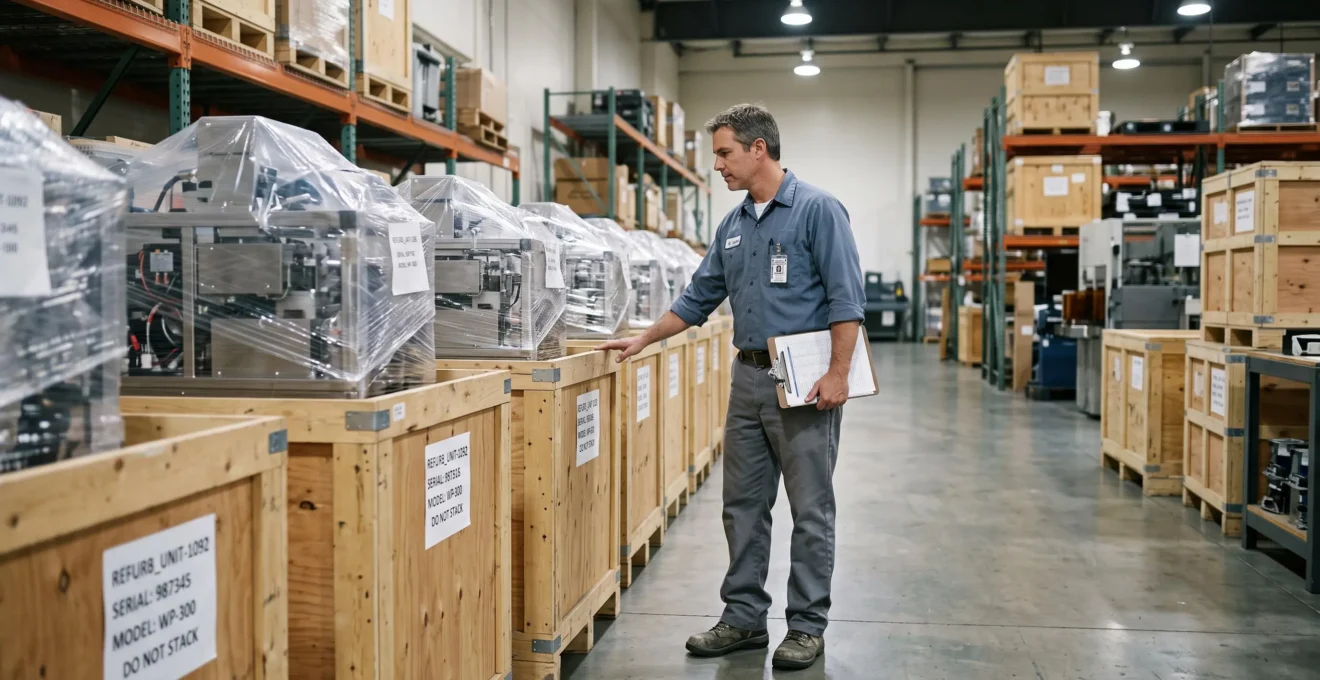
Exchange programs, sometimes called swap-out services, offer a middle ground: the failed pre-aligner is removed and replaced with a refurbished unit from provider inventory, allowing the line to resume operation quickly while the failed unit undergoes off-site repair. This model minimizes production downtime but depends on the provider maintaining a stock of compatible, pre-tested units and the ability to ship and install on a tight schedule.
Refurbishment involves sending the failed unit to a specialized facility where it is disassembled, inspected, repaired with OEM or OEM-equivalent parts, tested against original specifications and returned with documentation and warranty. Turnaround time is longer than an exchange but typically shorter than waiting for a new machine, and the cost is a fraction of replacement. The risk lies in the quality and traceability of the refurbishment process itself, which varies significantly across providers.
Comparing repair pathways: key decision criteria
- On-machine repair minimizes cost if parts are available but extends downtime and depends on internal expertise.
- Full replacement eliminates technical risk but imposes major capital expense and long lead times.
- Exchange programs reduce downtime by swapping a refurbished unit immediately, contingent on provider inventory.
- Off-site refurbishment balances cost and reliability but requires longer tool absence than an exchange.
| Pathway | Typical Downtime | Relative Cost | Parts Dependency | Process Risk |
|---|---|---|---|---|
| On-machine repair | Days to weeks | Low if parts available | High (requires spare inventory) | Moderate (depends on internal skill) |
| Full replacement | Weeks to months | Very high (capex) | None (new tool) | Low technical, high schedule |
| Exchange program | Hours to days | Moderate | Low (provider inventory) | Depends on provider certification |
| Off-site refurbishment | Weeks | Moderate | Low (provider sources parts) | Depends on test documentation |
The choice among these pathways depends on production urgency, budget constraints, internal technical capability and confidence in third-party provider quality. For lines where a single point of failure halts revenue-generating output, minimizing downtime often takes precedence over minimizing cost, making exchange programs particularly attractive if the provider can demonstrate reliable turnaround and verifiable quality standards.
How to evaluate a refurbished pre-aligner before committing
Skepticism toward third-party refurbishment is not unfounded; the precision required in wafer handling leaves little margin for degraded performance, and the absence of OEM oversight raises legitimate questions about parts authenticity, process rigor and long-term reliability. Buyers evaluating a refurbishment or exchange provider should demand transparency across several verification points before committing production equipment to an unproven process.
The first criterion is parts sourcing and traceability. A credible provider uses genuine OEM parts wherever available, supplemented by OEM-equivalent components that meet or exceed original specifications when OEM stock is depleted. The provider should document parts origin, supplier certifications and any deviations from original bill-of-materials. Refurbished units built with uncertified or reverse-engineered components may function initially but carry elevated risk of early failure or specification drift.
Process certification offers a second layer of assurance. Providers operating under ISO 9001 or equivalent quality management standards submit to external audits of their repair and testing procedures, creating enforceable accountability. While certification alone does not guarantee outcome quality, its absence should raise immediate concern. Buyers should request copies of current certifications and verify the certifying body’s legitimacy.
Repeatability and precision testing represents the most direct measure of refurbishment quality. Before accepting a refurbished pre-aligner, buyers should require documented test results demonstrating that the unit meets original equipment specifications for wafer centering accuracy, rotational repeatability and cycle time. These tests should be performed using calibrated metrology equipment traceable to national or international standards, with results provided in writing as part of the delivery package.
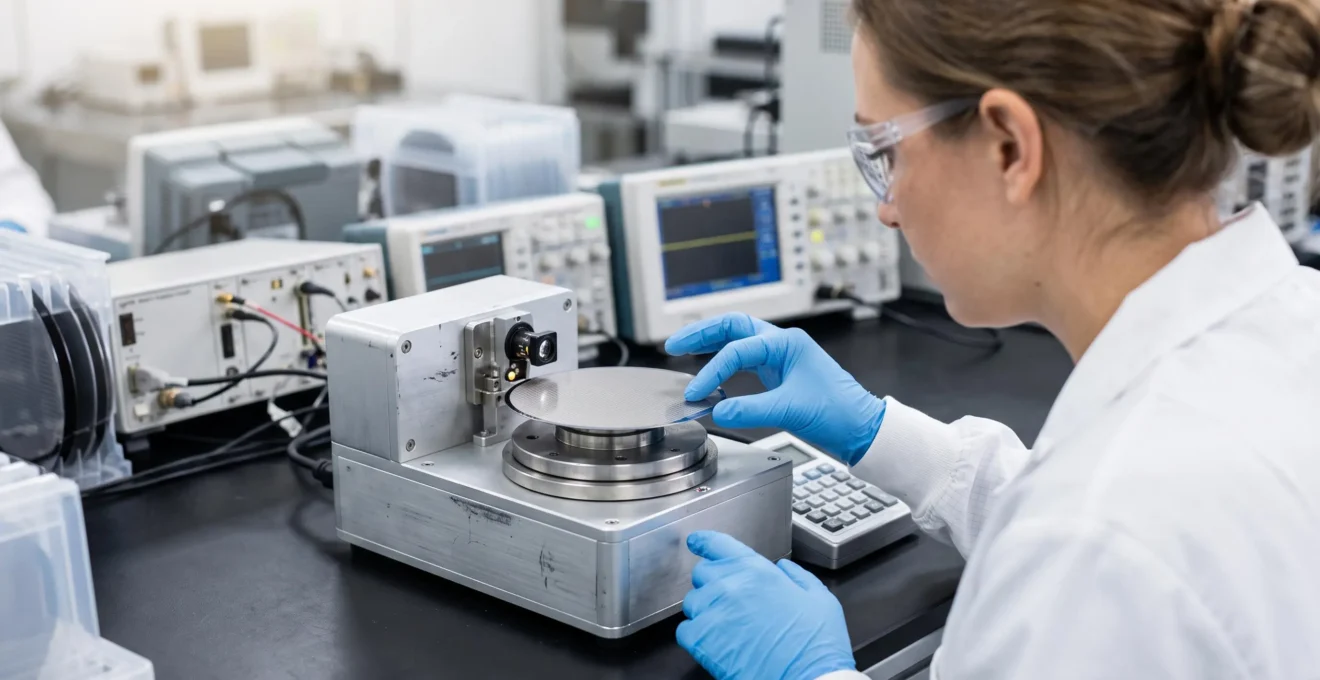
Warranty terms provide insight into provider confidence. A refurbished unit backed by a meaningful warranty period—typically six months to one year—signals that the provider stands behind the durability of their work. Conversely, minimal or absent warranty coverage suggests either low confidence in component longevity or insufficient post-delivery support infrastructure. Buyers should clarify what the warranty covers, what conditions void it and what the response time commitment is for warranty claims.
Model and brand compatibility must be verified explicitly. Not all refurbishment providers support all manufacturers or legacy model lines; a provider specializing in one OEM’s product family may lack the tooling, documentation or parts inventory to service another’s. Before initiating a refurbishment or exchange request, buyers should confirm that the provider explicitly lists their tool model and vintage as supported, and request examples of prior work on identical or closely related equipment.
- Parts sourcing:Are OEM-certified or OEM-equivalent parts used, and is traceability documentation provided?
- Process certification:Does the provider hold ISO 9001 or equivalent quality certification, and can they provide proof?
- Test documentation:Will the provider supply written test results demonstrating original-spec repeatability and precision?
- Warranty coverage:What warranty period is offered, what does it cover, and what are the response time commitments?
- Model compatibility:Does the provider explicitly support your equipment brand and model, with documented prior work?
Service-level commitments around turnaround time and communication further differentiate reliable providers from opportunistic ones. Exchange programs claim value through speed, yet speed is worthless if the replacement unit fails qualification testing upon installation. Buyers should request clarity on typical turnaround windows, expedited service availability, progress reporting during the repair cycle and the technical support channel for post-installation issues.
Cost, downtime and sustainability: the business case for extending equipment life
The economic justification for repairing or refurbishing legacy equipment rather than replacing it rests on three pillars: capital expenditure avoidance, production downtime reduction and waste minimization. Each contributes to a different stakeholder priority—finance, operations and environmental responsibility—but together they form a compelling argument for lifecycle extension strategies.
Capital avoidance is the most immediately quantifiable benefit. Semiconductor manufacturing equipment represents one of the highest capital intensity sectors in industrial production, with individual process tools ranging from hundreds of thousands to tens of millions of dollars. When a subsystem like a pre-aligner fails, replacing the entire tool to restore one component’s function imposes a financial burden disproportionate to the failure scope. Refurbishment costs typically fall to a small fraction of new equipment cost, freeing capital for other production investments or preserving budget in capital-constrained environments.
Downtime cost often exceeds direct repair cost, particularly in high-mix or high-value production lines. According to the real cost of unplanned downtime in manufacturing, reported by ReliaMag based on 2024 research from Siemens and Aberdeen, Fortune Global 500 manufacturers collectively lose an estimated $1.4 trillion annually to unplanned equipment stoppages, representing 11 percent of total revenue. In semiconductor fabs specifically, where wafer values can reach thousands of dollars per unit and production schedules are tightly sequenced, even brief interruptions cascade into yield losses, missed delivery commitments and revenue erosion. Exchange programs that restore a line to operation within days rather than weeks directly mitigate this financial exposure.
Environmental impact has emerged as a strategic consideration alongside financial metrics, driven by regulatory pressure, corporate sustainability commitments and supply chain resilience concerns. The semiconductor industry is actively transitioning toward circular economy models that prioritize equipment maintenance, refurbishment and component reuse over linear take-make-waste paradigms. SEMI’s announcement of the Circular Semiconductors Research Network in April 2025, developed in collaboration with imec, underscores industry recognition that extending equipment life and recovering materials delivers both environmental and strategic value, particularly as critical material supply chains face geopolitical and resource constraints.
Refurbishment reduces industrial waste by keeping functional mechanical assemblies, precision-machined components and control electronics in service rather than consigning them to scrap. While the exact environmental benefit varies by tool type and refurbishment scope, the principle is consistent: reusing an engineered system avoids the energy, raw material and manufacturing emissions associated with producing a replacement from scratch. For companies with quantified carbon reduction targets or extended producer responsibility obligations, documented refurbishment and lifecycle extension contribute measurable progress.
Inventory strategy offers a fourth economic dimension. Maintaining a stock of critical spare parts for EOL equipment ties up capital and warehouse space, yet the alternative—risking extended downtime during parts sourcing—is operationally unacceptable. Providers offering exchange programs with maintained inventory effectively externalize this holding cost, allowing fabs to operate with leaner internal spares while retaining rapid-response capability. The service fee paid for an exchange incorporates the provider’s inventory carrying cost, but the trade-off often favors the fab when internal stocking would duplicate effort across multiple sites or tool generations.
Industry context: SEMI, the international trade association representing the global electronics manufacturing and design supply chain, has identified circular economy practices—including refurbishment, component reuse and remanufacturing—as strategic priorities for both economic resilience and environmental responsibility across the semiconductor value chain.
Key takeaways for extending the life of your legacy semiconductor equipment
Decisions around legacy equipment repair and refurbishment require balancing immediate production needs against long-term reliability, cost control and risk management. The central insight is that OEM end-of-life status creates a procurement challenge, not a technical impossibility, and that multiple pathways exist to restore failed wafer handling equipment to specification—provided buyers apply rigorous evaluation criteria to third-party providers.
When evaluating whether to repair, exchange or replace a failed pre-aligner, prioritize the pathway that minimizes total cost of ownership, including both direct repair expense and the revenue impact of production downtime. Exchange programs reduce downtime but depend on provider inventory and turnaround commitments; off-site refurbishment offers cost control but extends tool absence; on-machine repair is lowest cost when parts are available but highest risk when they are not. No single pathway dominates across all scenarios, making the decision context-dependent.
Before committing to a third-party refurbishment provider, verify that they offer documented evidence of parts traceability, process certifications such as ISO 9001, repeatability test results traceable to calibration standards, meaningful warranty coverage and explicit compatibility with your equipment model. Providers unable or unwilling to supply this documentation should be excluded from consideration regardless of cost or turnaround claims.
The broader context of equipment lifecycle management extends beyond individual repair events. Fabs operating multiple generations of tools should assess their exposure to obsolescence across the entire line, identifying which subsystems are already EOL, which are approaching EOL and where critical single points of failure exist without spare parts or qualified repair channels. This assessment informs strategic decisions about which tools justify continued investment in repair infrastructure, which should be replaced during planned upgrades and where partnerships with specialized refurbishment providers deliver the most value.
Can an end-of-life pre-aligner be restored to original specification?
How long does a pre-aligner exchange or refurbishment typically take?
What warranty should I expect on a refurbished wafer handling component?
How do I verify that a third-party provider supports my specific equipment model?
The automation and precision demands of modern semiconductor manufacturing make equipment reliability non-negotiable, yet the financial and environmental costs of treating every component failure as a replacement trigger are increasingly untenable. For organizations seeking to balance operational continuity with responsible capital and resource management, the strategies and verification frameworks outlined here provide a foundation for making informed, defensible decisions when legacy equipment reaches the end of its OEM support lifecycle. Those evaluating how lifecycle extension and refurbishment fit within broader manufacturing efficiency strategies may find additional context in analyses of the impact of industrial automation on manufacturing efficiency.