
A single ungrounded operator opening a shielding bag can destroy thousands of pounds worth of integrated circuits in milliseconds. That risk vanishes when facilities implement seven conduct protocols within their electrostatic-protected area. These rules—rooted in IEC 61340-5-1 and ANSI/ESD S20.20—translate international standards into verifiable shop-floor actions, transforming EPA zones from theoretical compliance exercises into functional damage-prevention systems. UK electronics manufacturers adopting these protocols systematically reduce ESD-induced field failures whilst satisfying third-party certification audits.
The IEC 61340-5-1 standard emerged from decades of semiconductor industry collaboration, harmonising previously fragmented national approaches into a unified international framework. British Standards Institution adopted this specification as BS EN 61340-5-1:2016, establishing the benchmark against which UK electronics manufacturers demonstrate ESD control competency. This alignment enables facilities to satisfy both domestic certification requirements and international customer quality clauses through a single, coherent programme.
Systematic compliance matters because electrostatic discharge represents a category of failure particularly resistant to post-facto diagnosis. Unlike mechanical damage or thermal stress, ESD-induced latent defects may not manifest until weeks or months after the initial insult, when the component fails in the field under operational stress. Industry field-failure analyses consistently identify ESD as a contributing factor in 8–33% of premature semiconductor failures, translating to warranty costs, reputation damage and customer attrition that far exceed the investment required for proper EPA infrastructure.
Your EPA compliance snapshot: 7 non-negotiable controls
- Personnel grounding: wrist straps tested daily, resistance 1-10 MΩ loop
- Surface control: dissipative or conductive materials, resistivity 10⁴–10¹¹ Ω maximum
- Access protocols: ESD smocks, conductive footwear, prohibition of synthetic fleece
- Component handling: shielding bags mandatory until operator grounded within EPA
- Environmental monitoring: relative humidity 30-70%, ioniser balance ±50 V
- Documentation: daily logs, quarterly audits, calibration certificates retained
- Training programmes: induction mandatory, refresher cycles, near-miss capture
This compliance guide covers seven mandatory EPA control categories. Use the navigation below to access specific protocol sections directly.
- Compulsory personnel grounding: wrist straps and footwear
- Workstation earthing and surface resistivity control
- Controlled access and garment requirements
- Component handling and packaging protocols
- Environmental monitoring: humidity and ionisation
- Documentation and compliance verification
- Training, awareness and continuous improvement
Compulsory personnel grounding: wrist straps and footwear
Regulatory authorities consistently emphasise that personnel represent the primary electrostatic threat in electronics assembly. The human body accumulates charge through ordinary movement—walking across a floor, sliding a chair, even peeling adhesive tape. Without a controlled discharge path, that voltage can reach 15,000 V or more, far exceeding the 100 V threshold at which ANSI/ESD S20.20-2021 defines component vulnerability. Wrist straps create a resistive connection between the operator and a common earthing point, ensuring charge dissipates safely before contact with ESD-sensitive devices (ESDS).
IEC 61340-5-1 mandates wrist strap loop resistance between 1 and 10 megohms—tight enough to drain charge, yet sufficiently resistive to protect the operator from mains-voltage faults. Daily continuity testing using a dedicated wrist strap tester is non-negotiable; field audits consistently identify wrist strap failures as among the most common EPA non-compliances. Facilities establishing or upgrading their EPA zone require compliant wrist straps, mats and footwear; specialised suppliers offer complete equipment portfolios aligned with current British Standards adoption of IEC 61340-5-1:2016.
Consider a mid-sized electronics assembly operation audited for IEC 61340-5-1 certification: inspectors identified three operators wearing wrist straps with degraded cord conductors—daily continuity tests had been logged as “pass” using a faulty tester unit itself requiring calibration. The facility failed certification pending corrective action: all wrist straps replaced, tester calibrated against traceable resistance standard, and test procedures updated to include monthly tester verification. This scenario illustrates why test equipment integrity is as critical as the grounding equipment itself.
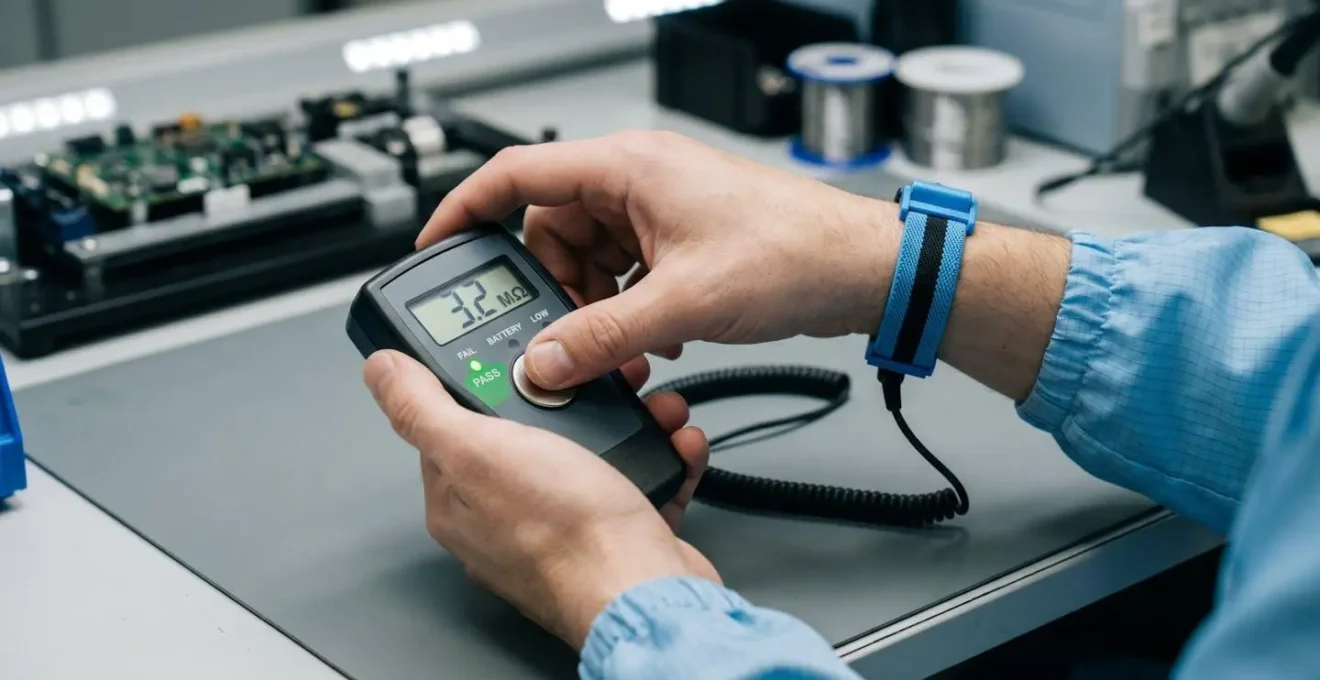
Conductive footwear or heel grounders serve as secondary grounding when operators move between workstations. Testing frequency mirrors wrist strap protocols: verify resistance weekly as a minimum, daily for high-volume production lines. Operators must understand the critical distinction—grounding is not a comfort measure but a mandatory safeguard, as fundamental to component integrity as clean hands are to surgical asepsis.
Workstation earthing and surface resistivity control
Grounding personnel achieves nothing if the work surface itself generates or traps charge. IEC 61340-5-1 classifies materials by surface resistivity: conductive surfaces measure below 10⁴ ohms per square, dissipative surfaces fall between 10⁴ and 10¹¹ Ω/sq, whilst insulative materials exceeding 10¹¹ Ω/sq are strictly prohibited within EPA boundaries. Conductive surfaces require direct hard-grounding; dissipative materials connect to earth via current-limiting resistors to prevent accidental short circuits.
The table below compares material characteristics, testing obligations and cost implications for facilities specifying EPA infrastructure.
| Material Type | Surface Resistivity (Ω/sq) | Grounding Required | Verification Interval | Cost Tier |
|---|---|---|---|---|
| Conductive (e.g., carbon-loaded vinyl) | <10⁴ | Hard ground (no resistor) | Quarterly resistance test | Medium-High |
| Dissipative (e.g., ESD rubber mat) | 10⁴–10¹¹ | Via 1 MΩ resistor | Quarterly resistance test | Medium |
| Insulative (standard plastic, untreated wood) | >10¹¹ | N/A (non-compliant) | Immediate replacement | Compliance risk |
| Common non-compliant: untreated MDF workbenches | >10¹² | Impossible to ground effectively | Retrofit with dissipative overlay | Low initial, high remediation |
| ESD-grade laminate bench top | 10⁶–10⁹ | Via common point ground | Quarterly verification | High (long service life offsets) |
Trolleys, component bins and tool handles must meet identical resistivity standards. The most frequently cited compliance gap involves facilities that ground workstations meticulously yet overlook mobile equipment—a charged trolley wheeled into the EPA negates every other precaution. Surface resistance testing using a megohmmeter becomes routine quarterly discipline, with results logged to demonstrate continuous compliance.
Controlled access and garment requirements
EPA zones function as controlled environments with entry protocols as rigorous as cleanroom airlocks. Signage at each access point must clearly designate the boundary and specify mandatory protective equipment. Personnel don ESD smocks manufactured from fabric blending conductive fibres (carbon or stainless steel threads) with standard textiles, creating a dissipative garment that equalises body voltage with the EPA ground plane. Smocks require laundering in non-ionic detergents—standard fabric softeners deposit insulative residues that destroy ESD properties.
Footwear options include dedicated ESD shoes (incorporating conductive soles) or disposable heel grounders worn over ordinary footwear. The latter prove cost-effective for visitors and infrequent EPA users. Entry checklists verify wrist strap connection and footwear before permitting access; some facilities install turnstiles with integrated continuity testers that physically block entry until grounding verification completes.
-
Synthetic fleece jackets, polyester jumpers or nylon outerwear (triboelectric charge generators)
-
Non-ESD lanyards for ID badges (standard plastic lanyards accumulate kilovolt charges)
-
Food, beverages and chewing gum (contamination and charge-generation risks)
-
Personal mobile phones and consumer electronics without dissipative cases
-
Transparent adhesive tape, bubble wrap and expanded polystyrene (unless ESD-grade variants)
Training reinforces that garments and grounding form a layered defence. Even a properly grounded operator can induce damage if their ungrounded colleague passes them a component—hence the requirement for universal compliance, no exceptions for management or visitors.
Component handling and packaging protocols
This protocol governs every moment an ESD-sensitive device exists outside its protective packaging. ANSI/ESD S20.20-2021 applies to components susceptible to damage at 100 volts HBM or greater—a threshold encompassing virtually all modern integrated circuits, discrete semiconductors and populated circuit boards. Shielding bags constructed from metallised multi-layer films create Faraday cages that block external electrostatic fields; components remain sealed within these bags until the operator is grounded at an EPA workstation.
The decision tree below guides protocol selection based on component sensitivity class and operator grounding status.
-
Is component Class 1 sensitivity (<1000 V HBM)?
Operator must be grounded via wrist strap before opening shielding bag. Component returned to bag immediately after assembly. Transport only in sealed conductive tote boxes.
-
Is component Class 2 (1000-4000 V HBM) or Class 3 (>4000 V)?
Grounding mandatory. Simplified workflow permits component removal to conductive foam trays. Pink anti-static bubble bags acceptable for internal facility transport.
-
Is operator ungrounded or outside EPA boundary?
STOP. Component must remain sealed in shielding bag. Industry best practice mandates components stay within packaging until within 30 cm of grounded workstation.
-
Rework or returns scenario?
Re-bag component in fresh shielding bag. Complete traceability label identifying date, operator and reason. Store in dedicated quarantine area within EPA. Failed components destined for failure analysis require identical packaging.

; bag interior reveals black conductive foam insert holding multiple integrated circuit chips. Grey dissipative workbench mat surface, pink conductive foam component tray positioned to receive ICs, edge of frame shows pink ESD bubble bag (processed components). Background (soft focus): metal shelving with organised ESD packaging—additional shielding bags, transparent conductive tote boxes. Natural, careful hand gesture mid-task (not posed for camera). Even overhead LED lighting with slight side accent emphasising bag metallic texture. Colour palette: industrial grey, silver metallised film, pale blue smock, pink/black foam accents. Deliberate, methodical atmosphere. Shot with 35mm lens, f/4 aperture, ISO 320. –no metaphor, no symbolic object, no abstract composition, no infographic style, no isometric illustration, no flat design illustration, no diverging paths illustration, no balance scale, no conceptual diagram replacing real scene, no schematic representation of an abstract concept, no triptych, no split image, no collage of separate photographs, no vertical arrangement on horizontal canvas, no large empty side margins, no unbalanced composition leaving more than 20% of the frame empty on either side, text, logo, brand, watermark, finger pointing, handshake, looking at camera, 3d render, plastic feel, vintage technology, CRT screen, old computer, rotary phone, timestamp overlay, date stamp, mirror reflection with inconsistent content, document showing both sides simultaneously, lightbulb, magnifying glass, gears, puzzle piece, upward arrow isolated, shield icon, brand logos on clothing or equipment, artificial gaussian blur on focal subject, generic anonymous office, generic corporate meeting, color blocks symbolizing flavors or ideas, isometric 3D map or icon illustration, flat icon set, symbolic color palette without real subject, vector-style illustration, no generic corporate office, text in non-English languages, mixed-language signage; STRICT REQUIREMENT: any visible text on signage, equipment labels, or documentation must be in English (en-GB) OR completely illegible/blurred.”>
Packaging selection mirrors component value and sensitivity. Silver metallised shielding bags offer maximum protection for critical devices; pink anti-static polyethylene provides basic static dissipation for lower-risk items. Transparent conductive polypropylene boxes enable visual inventory whilst maintaining ESD protection. Proper packaging discipline eliminates preventable expense—industry data compiled by the IEEE demonstrates that ESD damage costs range from pence for basic diodes to thousands of pounds for advanced ICs, with rework and logistics multiplying those figures.
The integration of industrial automation into component handling—robotic pick-and-place systems, collaborative robots—introduces hybrid challenges requiring grounded end-effectors and conductive vacuum cups, whilst collaborative robots working alongside human operators demand continuous monitoring to ensure the EPA ground plane extends to all mechanical interfaces. Automated systems cannot override fundamental physics—charge dissipation pathways remain mandatory regardless of handling method.
Environmental monitoring: humidity and ionisation
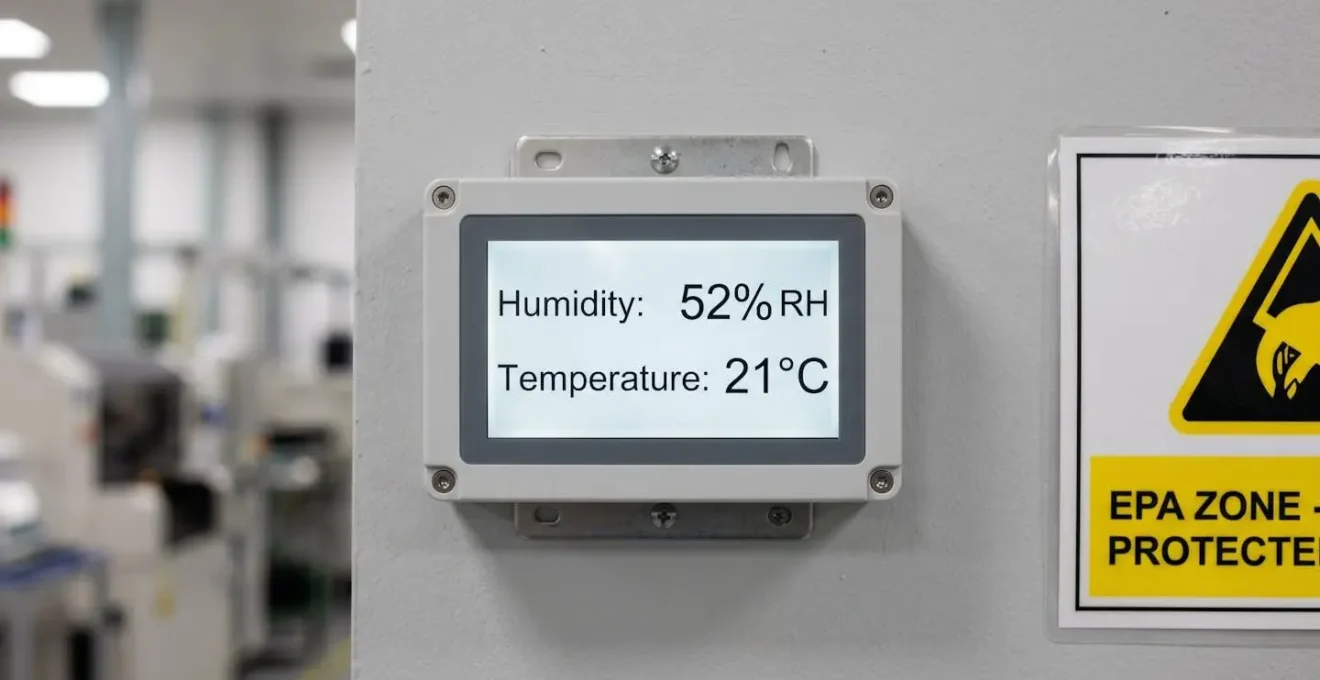
Atmospheric conditions profoundly influence triboelectric charging rates. Relative humidity below 30% creates desert-dry air that accelerates charge generation—a single footstep on synthetic carpet can generate 35,000 V in low-humidity environments. Moisture molecules in humid air provide conductive pathways that naturally dissipate static, which explains why IEC 61340-5-1 specifies 30–70% relative humidity as the acceptable EPA range. Facilities in UK climates rarely struggle with upper humidity limits but require active humidification during winter heating seasons when indoor air dries dramatically.
Wall-mounted hygro-thermometers with data-logging capability provide continuous verification. Alarm thresholds trigger corrective action before humidity excursions compromise component safety. Temperature stability (typically 15-25°C) matters less for ESD control than for thermal shock prevention, though wide temperature swings can drive humidity fluctuations.
Ionisers neutralise static charge on insulative materials that cannot be eliminated—computer monitors, acrylic component bins, printed documentation. These devices emit balanced streams of positive and negative ions that recombine with opposite charges on nearby surfaces, driving accumulated voltage toward zero. Ioniser balance must remain within ±50 volts; imbalanced units can worsen problems by depositing net charge onto components. Calibration using charged-plate monitors occurs at six-month intervals minimum, with performance certificates retained as audit evidence. Overhead ionising blowers suit general EPA environments, whilst benchtop units provide localised neutralisation for inspection and rework stations.
Documentation and compliance verification
Unrecorded compliance holds no weight during certification audits or customer assessments. Systematic documentation transforms daily ESD controls from transient activities into permanent, traceable evidence. Industry consensus holds that comprehensive records represent the facility’s primary defence against certification failure or liability claims following field failures.
Daily wrist strap test logs capture operator name, date, test result (pass/fail) and tester serial number. Quarterly surface resistance reports document bench mat measurements, floor tile readings and trolley conductivity, noting any values approaching specification limits. Ioniser calibration certificates confirm balance tolerances and decay times. Personnel training records prove competency, listing course content, trainer credentials and refresher dates. The incident register logs near-miss events—ungrounded personnel observed in EPA, damaged shielding bags discovered, humidity alarms—alongside corrective actions taken.
-
Daily wrist strap continuity test logs with 365-day retention minimum
-
Quarterly surface resistance measurement reports for all work surfaces, flooring and mobile equipment
-
Ioniser calibration certificates (annual minimum, six-month recommended) with balance and decay performance data
-
Personnel training records: initial ESD awareness, EPA-specific protocols, annual refresher completion
-
ESD incident and near-miss register with root cause analysis and preventive action closure
-
Third-party audit reports and corrective action plans demonstrating continuous improvement cycles
Digital record systems with timestamp authentication and edit-locking provide superior traceability compared to paper logbooks. Cloud-based platforms enable remote audit access, reducing disruption during certification visits. Whichever system you adopt, the principle remains constant: if it is not documented, it did not happen.
Training, awareness and continuous improvement
Perfect infrastructure fails without operator buy-in. ANSI/ESD S20.20 mandates that all personnel handling ESDS must receive ESD awareness training, covering electrostatic fundamentals, damage mechanisms, facility-specific protocols and individual responsibilities. Induction training precedes EPA access; refresher cycles (annual minimum, quarterly optimal) reinforce discipline and update personnel on procedure changes.
Field experience demonstrates that facilities with quarterly refresher programmes sustain higher audit pass rates than those relying solely on annual sessions. Training effectiveness improves when using actual facility equipment—demonstrating wrist strap testing on the shop floor proves more memorable than classroom PowerPoint slides. Capturing near-miss events (“I saw an operator without a wrist strap”) creates feedback loops that identify training gaps before they cause damage.
Continuous improvement extends beyond training to technology adoption. Field adoption of advanced manufacturing technologies creates opportunities for automated compliance monitoring: smart wrist straps with wireless connectivity that log connection status in real time, floor sensors that map personnel movement and grounding continuity, machine vision systems verifying packaging integrity before component removal. These innovations do not replace fundamental protocols but enhance traceability and reduce human error.
Establishing a culture where ESD protection is as reflexive as wearing safety glasses requires consistent leadership messaging, visible management compliance and recognition of exemplary practice. Facilities that achieve IEC 61340-5-1 certification often report that the discipline required for EPA protocol adherence improves broader quality management systems—the attention to detail, procedural rigour and documentation habits transfer to other manufacturing domains.
How often must wrist straps be tested—is daily testing excessive?
Daily testing is the industry standard and far from excessive. Wrist strap failures occur through cord damage, snap fastener wear and conductive element degradation—all of which can happen overnight. A five-second continuity test each morning prevents eight hours of unprotected component handling. Facilities audited for IEC 61340-5-1 certification must demonstrate daily test logs; gaps in records constitute automatic non-conformance.
Can I simply ground the workbench instead of requiring each operator to wear a wrist strap?
Bench grounding alone is insufficient. The operator’s body remains an isolated charge reservoir until directly connected to earth—air gaps prevent electron flow. Wrist straps create the resistive path necessary for continuous charge dissipation. Some facilities supplement wrist straps with conductive flooring and footwear, creating redundant grounding paths, but these augment rather than replace primary wrist strap requirements.
What is the functional difference between pink anti-static bags and silver shielding bags for ESD protection?
Pink bags are static-dissipative polyethylene; they prevent charge generation through friction but offer no shielding against external electrostatic fields. Silver metallised bags provide Faraday cage shielding, blocking external fields that could induce damage during transport through uncontrolled environments. Use silver shielding bags for sensitive components (Class 1 and 2) and inter-facility shipping. Pink bags suit internal EPA transport of lower-sensitivity items where the environment is already controlled. Never substitute one for the other based solely on cost.
Is humidity control truly necessary or merely best practice?
Humidity control is a codified requirement within IEC 61340-5-1 environmental specifications, not optional guidance. Below 30% RH, triboelectric charging accelerates exponentially—ordinary movements generate kilovolt potentials that even robust grounding cannot safely dissipate at the rate charges accumulate. UK facilities experience this acutely during winter when heating systems dry indoor air to 15-20% RH. Installing humidification is core EPA infrastructure alongside grounding and surface control.
How do I demonstrate EPA compliance to client audits without hiring a third-party consultant?
Prepare the six-category documentation set detailed in this guide: daily wrist strap logs, quarterly surface resistance reports, ioniser calibration certificates, training records, incident registers and previous audit corrective actions. Ensure test equipment carries current calibration stickers traceable to national standards. Conduct a self-audit using the IEC 61340-5-1 checklist one month before the client visit, addressing any gaps immediately. Client auditors seek evidence of systematic control, not perfection—documented protocols with minor non-conformances under corrective action demonstrate stronger programmes than undocumented “perfect” compliance claims.
This guide reflects general EPA best practices as of 2026; specific facility requirements may vary by sector and national regulation. Implementation must be validated against the latest versions of IEC 61340-5-1 and ANSI/ESD S20.20. Site-specific risk assessments and third-party audits remain mandatory for certification. Staff training programmes must be delivered or accredited by recognised ESD trainers. This content is provided for informational purposes. Adhere to current regulations and consult an accredited ESD consultant or HSE-approved safety engineer before implementing any safety procedures.